Neuralink: Technology, Neurotechnology & Cybersecurity by Agrita Anand
What happens when your brain becomes a connected device?
Introduction
The release of ChatGPT marked a turning point in public awareness of artificial intelligence. Suddenly, everyone was talking about machines that could think, write, and reason. But while the world debated language models, a quieter and arguably more profound revolution was unfolding in an operating room.
One of the most consequential frontiers in modern technology is the development of implantable devices for neurological conditions, specifically Brain-Computer Interfaces (BCIs) designed to restore function to people with severe paralysis. At the center of this frontier is one company: Neuralink.
This is not science fiction. The device exists, the trials are underway, and the implications both extraordinary and deeply concerning demand serious attention.
What Is Neuralink?
Neuralink is an American neurotechnology company that has developed fully implantable Brain-Computer Interfaces. Its core product, known as the Link, is a wireless BCI that reads electrical signals from neurons in the brain and translates them into commands for external devices computers, phones, robotic arms, and more.
After years of preclinical research, Neuralink received approval from the US FDA in May 2023 to begin human clinical trials. The era of mind-controlled computing had officially begun.
How It Works
The device is housed inside a coin-sized implant placed just beneath the skull. From it extend 64 ultra-thin, flexible wires each thinner than a human hair. Each wire carries 16 electrodes (tiny sensors), giving the implant a total of 1,024 sensing points embedded across different regions of brain tissue. A robotic needle weaves these threads into the brain like spread-out tentacles, listening silently to neurons as they fire.
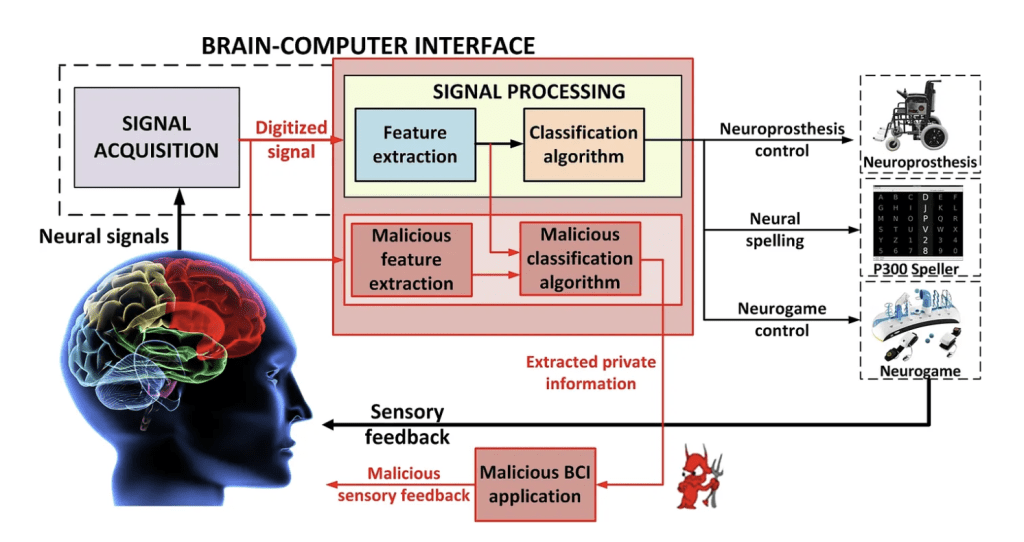
The signal pathway works like this:
Neurons fire → When you think about moving your hand, specific neurons produce distinct electrical patterns in the motor cortex.
Electrodes capture → All 1,024 electrodes simultaneously record the electrical activity around them, building a rich, real-time neural map.
Wireless transmission → The implant’s built-in Bluetooth transmitter broadcasts the data wirelessly, travelling only a few centimetres to a receiver outside the body. No cables. Completely invisible.
AI decoding → Machine learning algorithms match the neural pattern to a pre-learned action move cursor, select key, lift arm.
Device responds → The decoded command is sent to the connected device. The cursor moves. The keyboard types. Thought becomes action.
As Elon Musk put it on a live webcast: “It’s kind of like a Fitbit in your skull with tiny wires.”
Animal Trials: Proof Before People
Before any human received the device, Neuralink conducted rigorous animal trials to establish both safety and proof-of-concept.
Gertrude the pig had a Neuralink chip implanted in her motor cortex. As she sniffed her environment, researchers could watch real-time neural spike patterns firing on a live display demonstrating that the device could faithfully record neural activity from a living brain.
Pager the macaque monkey took things further. After implantation, Pager played the video game Pong on a screen entirely with his mind. The joystick was physically disconnected from the computer. His brainwaves moved the paddle. The footage of this moment became one of the most-watched technology demonstrations of the decade, offering the world its first visceral glimpse of what BCIs could actually do.
Brainwave Authentication: The Password You Can Never Forget
One of the most remarkable applications emerging from BCI technology is brainwave authentication a fundamentally new way of verifying identity.
Traditional authentication relies on something you know (a password), something you have (a phone or token), or something you are (fingerprint or face scan). All of these can be stolen, replicated, or forgotten.
Brainwave patterns are different. They are generated by the unique electrical activity of your neurons in response to specific thoughts patterns so individual that even the same person cannot perfectly reproduce the exact same pattern twice. This makes them nearly impossible to fake or steal.
In practice: you think a specific thought, Neuralink records the exact pattern your neurons produced, and the system compares it against your stored neural signature. If it matches, you’re authenticated. No PIN. No password. No phone.